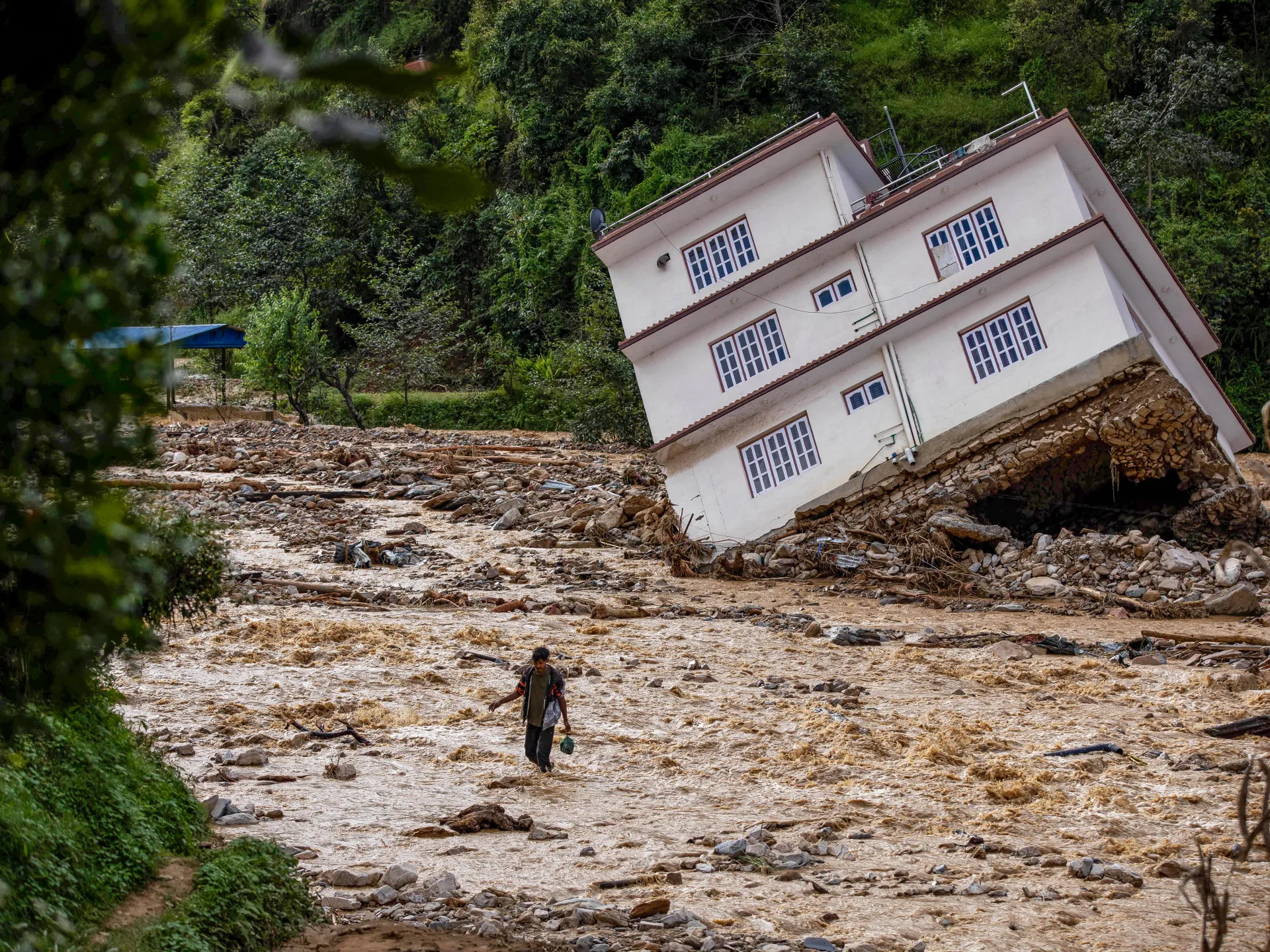
Quick Answer: On the morning of 26 August 2026, a glacier collapsed above Nepal's Langtang range and sent 100–200 million cubic metres of ice, rock and meltwater down the Bhote Koshi and Trishuli rivers at roughly 180 km/h. More than 700 people are dead across Nepal and Tibet and around 3,000 are still missing, including hundreds of Indians. Nepal put over 18,700 of its own soldiers and police into the valley — and then turned down every foreign search-and-rescue team that offered to come, including India's NDRF. It kept the money, the tarpaulins and a handful of tunnel specialists. It refused the manpower. This is the full account of what happened, what India did and did not get to do, and why Nepal said no.
There were seven minutes.
That is the gap between the moment a mountain came apart above the Langtang valley and the moment the water reached Gyirong Port on the Chinese side of the border. Seven minutes, for a valley full of people who had no reason on a clear August morning to look up.
It matters who was in that valley, because the casualty lists that followed read like a cross-section of everything the Nepal–Tibet border corridor does. There were seventy-three Indian workers at the Trishuli-1 power project, men who had gone to build a hydropower station on a fast river. There were pilgrims returning from the Kailash Mansarovar Yatra, at the end of a journey people save for years to make. There were trekkers on the Langtang circuit in the last good weeks of the season — Ukrainians, Malaysians, Australians, Britons, Americans. There were Nepali tourists from Kathmandu and the Terai. There were traders and drivers at the Rasuwagadhi customs post, where more than three hundred vehicles were parked. And there were the people who simply live there: the residents of Timure, Syabrubesi, Dhunche and Mailung, whose villages sit where they have always sat, beside the river.
By the end of that week, bodies from this valley had been recovered 240 kilometres away, in the Kushinagar and Maharajganj districts of Uttar Pradesh.
What Actually Happened: A Glacier, Not a Cloudburst
Almost every Himalayan flood story of the last decade begins with rain. This one does not, and that distinction is the single most important thing to understand about it.
At 08:37 Nepal time, seismographs registered what initially read as an earthquake — the United States Geological Survey logged it at Ms 5.2, later revised to Mw 5.7. It was not tectonic. It was the seismic signature of a mountain letting go.
An unnamed glacier roughly 610 metres wide, sitting between 5,200 and 5,400 metres near Langtang Lirung, detached and fell about 1,200 metres. Geomorphologists estimate the collapsed mass at 100 to 200 million cubic metres. Friction from that fall melted much of it on the way down, and the resulting slurry of meltwater, ice and shattered rock displaced the river below and pushed it out of its bed.
The debris front moved at approximately 50 metres per second — about 180 kilometres per hour. It ran 72 kilometres down the Trishuli. In places it reached settlements sitting 80 metres above the normal waterline. Silt deposits more than 1.5 metres deep were later measured 80 kilometres downstream.
Scientists have been careful and honest about the climate question. Warming permafrost very likely weakened the rock and ice holding that glacier in place, and several researchers have said so plainly. Others have stressed that the proximate cause was geological rather than meteorological. Both things can be true. What is not in dispute is the practical consequence: this was a dry-season, clear-sky disaster on a river system whose entire warning apparatus was built around the monsoon.
The Toll, and Why the Numbers Kept Moving
If you followed this story in real time, you saw the figures climb all week, and it is worth explaining why rather than just picking one number. Nepal's count came from district administrations reporting upward; the missing were counted from hotel registers, project payrolls, trekking permits and family calls; and the Tibetan side was reported separately and far more sparsely. Early figures were floors, not estimates.
By 27 August, the reported death toll was around 359. By 28 August, 475 bodies had been recovered. By 29 August, the figures stood at roughly:
- Deaths: 734 or more in Nepal and at least 16 in Tibet — over 750 in total. The Associated Press reported more than 670 on 27 August; other agencies were carrying 626 for Nepal the same weekend.
- Missing: about 2,498 in Nepal and 546 in Tibet — a combined figure above 3,000.
- Injured: more than 1,473 in Nepal.
- Rescued: 7,514 by Nepal's National Disaster Management Authority count, including 227 foreign nationals.
Of the missing in Nepal, 589 were foreign nationals: 288 Indians, 90 Americans, 53 Ukrainians, 51 Malaysians, 35 Australians, 33 Britons and around 100 Chinese citizens, alongside 127 Nepali tourists from other parts of the country.
Some of the hardest details of this disaster are administrative ones. Morgues in Rasuwa and Nuwakot filled within two days. The dead were moved out to Bhairahawa, Bharatpur, Butwal, Gorkha, Kathmandu, Nawalparasi, Palpa and Pokhara. When cold storage ran out, many unidentified bodies had to be buried temporarily — which means a number of families are now waiting not only for news, but for an exhumation and a DNA match before they can be told anything at all. That is the quiet reason Nepal later asked for foreign forensic help. It is also why the missing figure will fall slowly, and painfully, for months.
What the Water Took
The damage runs along a 72-kilometre corridor through Rasuwa, Nuwakot, Dhading, Gorkha, Tanahun, Nawalparasi and Chitwan. Nepal's preliminary government estimate put the total at around Rs 200 billion — upwards of USD 1.3 billion — by 27 August.
- Roads and bridges: 41 bridges damaged, 42 kilometres of road destroyed, an estimated Rs 15 billion in itself. The Trishuli Bazaar bridge was swept away. The Prithvi Highway was blocked between Baireni and Mugling until 28 August. The Syafrubesi–Rasuwagadhi road, repaired after the 2025 flood, was cut again.
- Power: six major hydropower and transmission facilities hit — Rasuwagadhi, Chilime, Trishuli 3A, the Trishuli 3B Hub 220 kV substation, Trishuli Hydropower Station and Devighat. That removed 431 MW from an already strained national grid in one morning, with another 470 MW of under-construction capacity damaged.
- Public buildings: at least 20 schools damaged across Rasuwa, Nuwakot and Dhading. The rural municipality offices at Gosaikunda and Uttargaya were washed away entirely, along with the Rasuwagadhi customs office and 300-plus vehicles.
- Across the border: the Gyirong Port complex — the main trade gateway between Nepal and Tibet — was destroyed.
Then, on 27 August, a second threat: Chinese authorities warned that a barrier lake of about 2 million cubic metres had formed near the confluence of the Chhochen Khola and Purepu Tsangpo, with another 3 million cubic metres of inflow expected by 30 August. Rescue work was suspended when it overflowed on 28 August. It drained slowly instead of bursting. That is very likely the only reason this article is not describing a second disaster on top of the first.
Nepal Sent Its Own Army, and Sent It Fast
Before getting to what Nepal refused, it is only fair to record what Nepal did — because the refusal makes no sense without it.
The government declared the affected area a disaster zone for three months under the Disaster Risk Reduction and Management Act, 2074, and put more than 10,000 uniformed personnel into the field within days:
- Nepali Army: around 4,200 in the initial mobilisation, rising to more than 8,300 deployed across the affected districts by 30 August, per The Kathmandu Post. Roughly 2,000 were assigned specifically to aerial and ground search-and-rescue, flying army helicopters alongside chartered private ones.
- Armed Police Force: around 4,200.
- Nepal Police: around 4,800.
- Total rescuers deployed by 29 August: more than 18,700 across all agencies.
In Rasuwa alone, the Nepali Army had brought out 2,697 people by 7am on 30 August — 2,497 lifted by air from Timure, Syabrubesi, Dhunche and Mailung, and 200 by ground teams. Among them were 216 foreign nationals: 121 Indians, 72 Chinese, 15 South Koreans, four Germans, two Americans, two Italians and one Omani. The army had also moved eight tonnes of relief supplies into Rasuwa by 27 August.
Prime Minister Balendra Shah reached Nuwakot on 27 August. On 28 August he and his entire council of ministers decided to deposit a month's salary each into the Prime Minister's Disaster Relief Fund, and directed the Finance Ministry to prepare a relief and rehabilitation package for affected individuals and businesses. The fund had collected Rs 5.44 billion by 29 August — nearly Rs 2 billion of it in the first 36 hours.
What Nepal Said No To — and Exactly Why
Within forty-eight hours, the offers arrived, and a striking share of them were offers of people: trained search-and-rescue contingents, packed and waiting for clearance.
India offered to deploy the National Disaster Response Force. The United Kingdom offered a search-and-rescue team. Malaysia had its Special Malaysia Disaster Assistance and Rescue Team on standby. Pakistan dispatched emergency teams. South Korea deployed a response team. China offered as well. The United States offered.
Nepal's Ministry of Foreign Affairs turned the rescue teams down — India's, China's, and the others.
The official line was brief and unusually plain. Foreign Ministry spokesperson Lok Bahadur Chhetri put it this way: The offer for help is natural. Our security agencies are doing the search and rescue operation. For now we don't require such help.
Behind that sentence is a specific institutional memory, and Nepali officials have not hidden it. A senior Foreign Ministry official said the government had weighed the coordination and management problems caused by the influx of foreign search-and-rescue teams during the 2015 earthquake
when deciding against accepting similar teams now.
This is not a vague grievance. After the 2015 Gorkha earthquake, peer-reviewed assessments found Nepal was simply overwhelmed by the sheer volume of personnel, equipment and donations arriving — and that the resulting congestion actively damaged planning, aid provision, delivery and distribution. Kathmandu has one international airport. In 2015 it became the bottleneck through which every rescue team, every pallet and every camera crew had to pass, and teams landed faster than any Nepali authority could tell them where to go or what had already been searched. Some arrived after the survivable window had closed. The country spent scarce capacity hosting its helpers.
So in 2026, Kathmandu made a different call: keep the money, keep the material, keep command of the ground — and don't import manpower we already have. With 18,700 personnel in the field, the claim of sufficiency was at least defensible on its own terms.
There is a reasonable criticism of this decision, and it deserves stating rather than burying. Nepal's own agencies are not equipped for every task a disaster of this shape produces — tunnel rescue, mass DNA identification, heavy air-lift into cut-off terrain. In the first days, that gap was real, and the missing count was enormous. Nepal ultimately conceded the point in a narrow, specific way, which we will come to. Whether the delay between refusing and conceding cost lives is a question Nepali journalists and Nepal's own parliament are better placed to answer than anyone outside the country. It should be asked. It should not be answered from a distance with confidence nobody actually has.
India: What It Did, What Was Refused, What Was Accepted
India's position in this disaster is more complicated than either India rushed to help
or Nepal snubbed India
, and both framings have been circulating. The record is more specific than either.
What India offered — and what was declined
India offered to deploy the National Disaster Response Force, its dedicated disaster response body and the same force that went into Nepal in 2015. Nepal declined the deployment. Chhetri's statement confirmed that India's offer was turned down alongside China's and others' — this was a category decision about foreign rescue personnel, not a decision about India.
That distinction matters, and it is where a lot of commentary has gone wrong. Nepal did not single India out. It applied the same answer to Beijing, London, Kuala Lumpur and Washington.
What India sent anyway
Having been told not to send people, India sent material — quickly, and by military airlift.
- Late on 26 August, the day of the disaster, an Indian Air Force C-130J delivered the first 10 tonnes of relief material.
- By 28 August, India had dispatched 47.5 tonnes across two flights, with a third flight loaded and waiting on clearance.
- By 29 August the cumulative figure had reached roughly 62 tonnes, alongside medical personnel.
The pattern is worth naming honestly: the aircraft that would have carried the NDRF carried tarpaulins instead. India adapted its offer to the answer it got rather than withdrawing it — which, in the diplomacy of disasters, is not a small thing.
The 288: India's other operation
India was also running a second, quieter emergency, because a large number of the missing were its own citizens.
On 27 August the Ministry of External Affairs reported 288 Indian nationals uncontactable in Nepal and released state-wise details so families could check. The missing fell into identifiable groups — most prominently the 73 Indian workers at the Trishuli-1 power project and pilgrims returning from the Kailash Mansarovar Yatra, along with trekkers and traders.
The MEA opened a 24-hour control room in Delhi, and round-the-clock helplines at the Indian missions in both Kathmandu and Beijing — the second because a meaningful number of Indians were on the Tibetan side of the border, in territory India cannot access directly. The Kathmandu embassy published emergency numbers: +977-9851316807 (emergency helpline), +977-9851107021 (Attaché, Consular) and +977-9749833292 (ASO, Consular).
By 30 August, 108 Indians had been rescued and contact had been restored with about 50 more, leaving over 275 still unaccounted for. Almost all of those rescues were physically carried out by Nepali Army helicopters — 121 Indians were among the 216 foreign nationals the army lifted out of Rasuwa. Indian consular staff worked the identification and family-notification side while Nepali crews flew the sorties. That division of labour is, in practice, exactly what Nepal's policy was designed to produce.
What Nepal did accept from India
Three things, and they are not trivial:
- Relief material and medical personnel — the tonnage above.
- Tunnel-rescue experts. When workers were trapped at the damaged hydropower stations, Nepal specifically requested tunnel specialists from India and China. Teams from both countries arrived on Saturday 29 August. This is the exception that defines the rule: Nepal wanted expertise it did not have, not headcount it did.
- 25,000 metric tonnes of DAP fertiliser. On 28 August the Nepali cabinet gave in-principle approval for Krishi Samagri Company Limited to buy 25,000 MT of DAP from India through government-to-government procurement. This got almost no coverage and deserves more. The flood tore through farmland in the middle of the agricultural calendar, and Nepal depends on Indian fertiliser imports. A disaster that destroys a planting season becomes a food-security problem six months later. This was Kathmandu acting on the second disaster before the first one had finished.
So the fair summary of India's role: its rescue force was turned away as part of a blanket policy, its relief flights were accepted from day one, its specialists were requested by name when a specific need appeared, and its largest single contribution may end up being fertiliser rather than anything that happened in the first week.
What the Rest of the World Sent
Nepal routed contributions through a deliberate one-door
mechanism, so aid went through the central government rather than dozens of independent channels — another direct lesson from 2015.
- UAE: USD 10 million
- Australia: AUD 5 million
- Canada: CAD 5 million, plus five consular officials
- United Kingdom: GBP 5 million (its SAR team offer declined)
- United States: USD 3.6 million, raised from an initial USD 500,000, plus a disaster response advisor
- South Korea: USD 1 million in government aid; the Doosan Group separately pledged USD 5 million toward the damaged hydropower sites
- Sri Lanka: USD 1 million; Singapore: USD 100,000 via the Singapore Red Cross
- China, Japan, Bangladesh: emergency supplies — tents, blankets, jerrycans, food, water containers, body bags
- Multilateral: USD 5 million from the Asian Development Bank, USD 2 million from the UN Central Emergency Response Fund, EUR 2 million from the EU plus Copernicus satellite activation, CHF 1 million from the IFRC, USD 150,000 and medical supplies from the WHO, and an emergency team from Médecins Sans Frontières
Beyond the tunnel experts, Nepal eventually admitted a small number of specialists from India, China, Australia and South Korea for DNA testing and forensic examination — the direct answer to those temporarily buried, unidentified bodies. It also asked international partners for heavy-lift cargo drones to reach settlements the roads no longer reached.
Specialists yes. Contingents no. That is the entire policy in four words.
The Early Warning System That Warned No One
Nepali and Chinese scientists have maintained a flash-flood early warning system in this basin for years. It did not fire, and the reason should worry every downstream district in the Himalaya.
The water-level monitors were calibrated for monsoon and perennial flooding — gradual rises measured over hours. They were not built for a debris front travelling at 180 km/h in the dry season. And the upstream monitoring stations inside Nepal were destroyed by the flood before they could transmit anything at all. A senior fellow at the Stimson Center described the region as a monitoring blind spot
that had received minimal geological attention despite sitting directly beneath a glaciated massif.
Seven minutes passed between the seismic signature and the water reaching Gyirong Port. Even a perfect system would have bought very little. But a system tuned for the right hazard would have bought something — and further downstream, where the water took longer to arrive, it might have bought a great deal.
The Tibet Side, and What Cannot Be Verified
China's response was substantial and fast. Premier Li Qiang arrived in Gyirong on 26 August. The Tibet Autonomous Region deployed nearly 800 emergency workers with 150 vehicles, sniffer dogs and speed boats. The National Fire and Rescue Administration sent 681 personnel and 13 rescue dogs; the Ministry of Emergency Management added 60 personnel and tunnel experts. People's Armed Police, PLA and Sichuan provincial teams were mobilised. 499 residents and 555 tourists were evacuated. General Secretary Xi Jinping publicly called for improved disaster monitoring and warning systems.
At the same time, information from the Tibetan side was tightly controlled. Videos shot by locals were censored on Chinese social platforms. Xinwen Lianbo, the flagship state news broadcast, showed a single CCTV still frame. Several smaller state outlets published witness interviews that were removed within hours. Foreign journalists were denied access, with authorities citing terrain difficulty and secondary disaster risk.
The honest position for a reader is this: Nepal's figures are contested but independently reported and argued over in public. Tibet's are not independently verifiable. The 16 dead and 546 missing on the Chinese side should be read as a floor, not a total. Anyone presenting them as a final count — in either direction — is telling you more about their politics than about the valley.
What This Disaster Should Change
The hazard arrived out of season. Flood planning across Nepal, India and Bhutan is built around the monsoon calendar. A glacier detachment does not consult the calendar. Every district downstream of a glaciated basin now has to plan for a hazard that can arrive on a clear day in any month — and to fund monitoring that can detect a fall, not just a rise.
The infrastructure was in the path by design. Six hydropower facilities were hit because hydropower gets built exactly where the gradient is steep and the water is fast, which is exactly where a glacial debris flow does maximum damage. Nepal lost 431 MW from a strained grid in a single morning, plus 470 MW still under construction. This is a structural conflict in the region's development model, not bad luck.
A country was allowed to say no. Whatever one concludes about the decision, Nepal made a sovereign, reasoned choice grounded in documented experience of what went wrong the last time, and backed it with 18,700 of its own people. Aid, when it is offered, is offered to a government that is entitled to say not that, this instead.
Nepal did exactly that — and then, when a genuine capability gap appeared, was willing to reverse itself on the specific point rather than defend the position for pride. That is a more sophisticated piece of disaster diplomacy than it has been given credit for.
And the counting is not over. Three thousand people are still missing. Many will be found. Many will not, and their families are waiting on DNA labs and exhumations rather than helicopters now. That is the part of this story that will outlast the news cycle by years, and it is the part worth remembering when the figures stop updating.
Frequently asked questions
What caused the Nepal flood in August 2026?
Not rain. An unnamed glacier roughly 610 metres wide, sitting between 5,200 and 5,400 metres near Langtang Lirung, detached and fell about 1,200 metres on the morning of 26 August 2026. The collapsed mass is estimated at 100 to 200 million cubic metres. Friction melted much of it during the fall, and the resulting slurry of meltwater, ice and rock pushed the Bhote Koshi and Trishuli out of their beds. The USGS initially logged the event as a magnitude 5.2 to 5.7 seismic signal, but it was the glacier collapsing, not an earthquake.
How many people died in the Nepal flood 2026?
As of 29 August 2026, at least 734 people were confirmed dead in Nepal and at least 16 in Tibet, taking the total above 750. Around 2,498 people remained missing in Nepal and 546 in Tibet, a combined figure above 3,000, with more than 1,473 injured. The numbers rose through the week as district administrations reported upward, and the Tibetan-side figures should be treated as a floor because information from that side is not independently verifiable.
Why did Nepal reject foreign rescue teams?
Nepal's Ministry of Foreign Affairs declined offers of search-and-rescue teams from India, China, the United Kingdom, Malaysia, the United States and others. Foreign Ministry spokesperson Lok Bahadur Chhetri said, "The offer for help is natural. Our security agencies are doing the search and rescue operation. For now we don't require such help." Officials also cited the coordination and management problems caused by the influx of foreign rescue teams after the 2015 Gorkha earthquake, when Nepal's single international airport became a bottleneck and teams arrived faster than authorities could direct them.
Did India help Nepal during the 2026 flood?
Yes, substantially, though not in the form it first offered. India's National Disaster Response Force deployment was declined as part of Nepal's blanket policy on foreign rescue personnel. India then sent relief material by military airlift instead: 10 tonnes by IAF C-130J late on 26 August, 47.5 tonnes across two flights by 28 August, and roughly 62 tonnes with medical personnel by 29 August. Nepal specifically requested Indian tunnel-rescue experts, who arrived on 29 August, and approved a government-to-government purchase of 25,000 metric tonnes of DAP fertiliser from India on 28 August.
Why did Nepal refuse India's NDRF specifically?
It did not refuse India specifically. Nepal applied the same answer to every country that offered rescue personnel, including China, the United Kingdom, Malaysia and the United States. The decision was a category one about foreign manpower, not a bilateral signal to New Delhi. Nepal continued to accept Indian relief flights from day one and asked India by name for tunnel-rescue specialists when a capability gap appeared.
How many Indians are missing in the Nepal flood?
The Ministry of External Affairs reported 288 Indian nationals uncontactable on 27 August 2026 and released state-wise details. The largest identifiable groups were 73 workers at the Trishuli-1 power project and pilgrims returning from the Kailash Mansarovar Yatra, along with trekkers and traders. By 30 August, 108 Indians had been rescued and contact had been restored with about 50 more, leaving over 275 still unaccounted for. Most of those rescues were flown by Nepali Army helicopters.
Which districts and areas were affected?
The damage runs along a 72-kilometre corridor through Rasuwa, Nuwakot, Dhading, Gorkha, Tanahun, Nawalparasi and Chitwan districts in Nepal, and Gyirong County in the Tibet Autonomous Region on the Chinese side. Worst hit were the settlements of Timure, Syabrubesi, Dhunche and Mailung. Bodies were recovered as far as 240 kilometres downstream, in the Kushinagar and Maharajganj districts of Uttar Pradesh in India.
Was the Nepal flood caused by climate change?
Partly, and scientists have been careful about how they say it. Warming permafrost very likely weakened the rock and ice holding the glacier in place, which made the collapse more likely. Several researchers have also stressed that the proximate cause was geological rather than meteorological. The practical point both camps agree on is that this was a dry-season, clear-sky failure on a river system whose entire early warning apparatus was calibrated for monsoon flooding — and it therefore gave no warning at all.
Why did the early warning system fail?
The flash-flood warning system maintained by Nepali and Chinese scientists was built for monsoon and perennial flooding, meaning gradual water-level rises measured over hours. It was not designed to detect a debris front moving at 180 kilometres per hour. The upstream monitoring stations inside Nepal were destroyed by the flood before they could transmit anything. Only seven minutes passed between the seismic signature of the collapse and the water reaching Gyirong Port.
How can I donate to Nepal flood relief safely?
The Prime Minister's Natural Disaster Relief Fund is the Nepali government's designated single channel, and the Ministry of Home Affairs publishes the verified account details. The fund had collected Rs 5.44 billion by 29 August. Given the volume of fraudulent fundraising that followed the 2015 earthquake, verifying the channel before sending money is the most useful precaution you can take from a distance.
Who do I contact about a missing family member in Nepal?
For Indian nationals, the Indian Embassy in Kathmandu emergency helpline is +977-9851316807, with consular numbers +977-9851107021 and +977-9749833292, and the Ministry of External Affairs is running a 24-hour control room in Delhi plus a helpline at the Indian mission in Beijing for those on the Tibetan side. Nepal's Ministry of Foreign Affairs has set up an Emergency Response Team with a one-door mechanism through which relatives of foreign nationals can make contact directly.
Sources and Where to Follow the Story
Figures in this article reflect reporting up to 30 August 2026 and were changing daily. Reported numbers differed between agencies; where they conflicted, we have given the range and the date rather than picking one.
- The Kathmandu Post — daily district-level rescue figures from the Nepali Army
- Outlook India and The Week — on Nepal's decision to decline foreign rescue teams, including the NDRF
- India TV — MEA figures on Indian nationals and the control room
- Al Jazeera — cross-border coverage of the Nepal and China operations
- NBC News and NPR — casualty tracking
- UN News — humanitarian assessment and multilateral funding
- Nepal Ministry of Home Affairs — the official relief appeal and verified donation channels
If you want to help
The Prime Minister's Natural Disaster Relief Fund is the Nepali government's designated single channel, and the Ministry of Home Affairs page above carries the verified account details. Given the volume of fraudulent fundraising that followed the 2015 earthquake, checking the channel before you send money is not cynicism — it is the most useful thing you can do from a distance.
If you have family or colleagues unaccounted for in Nepal, the Indian Embassy in Kathmandu helpline is +977-9851316807, and the MEA control room in Delhi is operating 24 hours. Nepal's Ministry of Foreign Affairs has set up an Emergency Response Team with a one-door mechanism through which relatives of foreign nationals can make contact directly.


