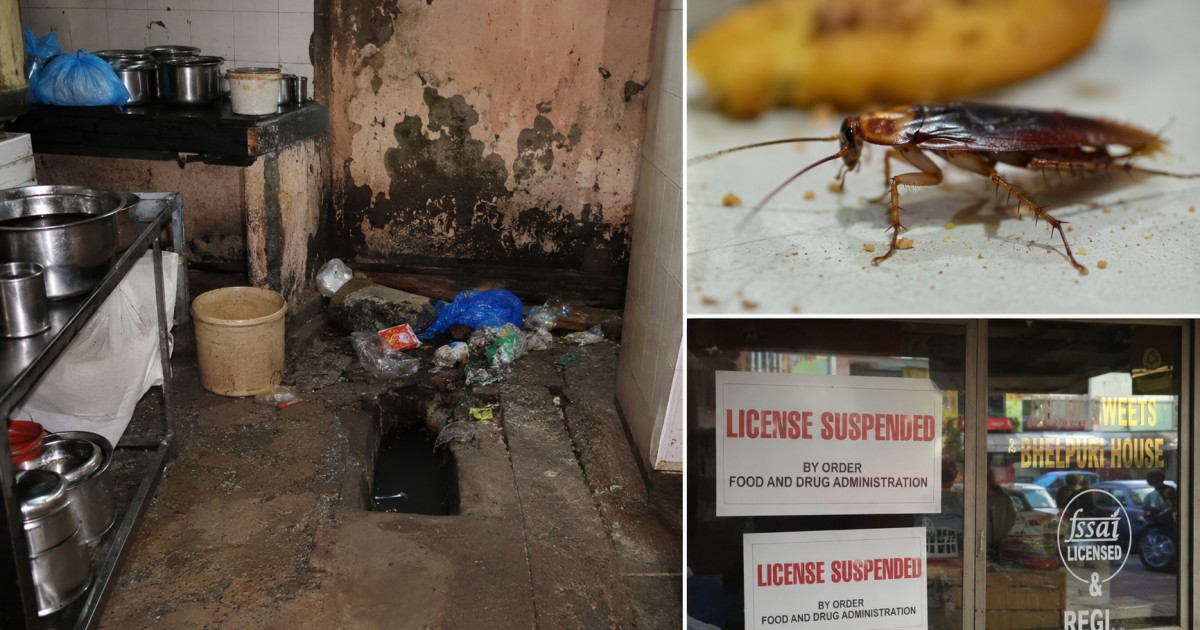
Cockroaches in the kitchen. Uncooked samosas sitting a few feet from an open drain. And a water tank nobody had bothered to get tested, feeding straight into the cooking pots. That's what Maharashtra's food inspectors found this past week, and it's why three food businesses in the state, including a Blinkit hub, had their licences pulled inside a matter of days.
This isn't a one-off. It's the latest hit in a crackdown that's been building since May 2026, and it's worth reading in full even if you've never ordered from any of these specific places, because the pattern behind it says something about where your food and water are actually coming from.
What the FDA Found: Three Locations, Three Separate Failures
Maharashtra's Food and Drug Administration didn't act on a single complaint. It acted on three separate inspection reports, each one worse than the last. Here's exactly what inspectors documented at each site.
Blinkit's Akola Hub: A Repeat Offender That Didn't Fix Anything
The FDA had already inspected this facility once and issued a formal improvement notice, giving the operator a chance to fix what was wrong. When inspectors returned for a re-check, nothing had changed. Food and non-food items were still stacked on the same racks. Food packets were sitting directly on the floor. Dust and garbage had piled up, and there was no regular cleaning schedule in place at all. That repeat failure, not a first-time slip-up, is what pushed the FDA to suspend the operator's licence outright on 1 September 2026, according to Business Today and The Week.
Delhi Sweet and Bhelpuri House, Malad West: The Untested Water Problem
An inspection on 25 August found uncooked samosas stored in a fridge right next to the utensil-washing area, close enough to pick up the smell of an open drain and stagnant water nearby. The kitchen itself had falling plaster and exposed bulbs hanging directly over the food prep counter.
But the detail that matters most is this one: the outlet was reportedly cooking and serving with water drawn from an unclean overhead tank that had never been tested, according to Free Press Journal. No water-testing report. No record of when the tank was last cleaned. That's the water that went into every cup of tea, every plate of bhel, and every glass served across the counter. The licence was suspended with immediate effect.
Gulzar Mohammedi Hotel, Kurla West: A Score of 24 Out of 88
A surprise inspection on 27 August gave this establishment a score of just 24 out of 88, or 28 percent. Inspectors documented broken flooring, peeling plaster, weak pest control, wilted and rotting vegetables still in use, cooked food left out in the open, and live cockroaches moving through the kitchen. The registration certificate was suspended on 31 August, per the same Free Press Journal report and corroborated by The Logical Indian.
Why the Water Detail Matters More Than the Cockroaches
Everyone's first reaction to a story like this is about the roaches. Fair enough, that's the visceral part. But the untested tank water at the Malad outlet deserves more attention than it's getting, because it's rarely a one-restaurant problem. An overhead tank that hasn't been cleaned or tested doesn't just serve one shop, and the water going into your food often comes from the exact same source as the water coming out of your own tap.
This is the same story playing out at a much larger scale across urban India. A Down To Earth analysis covering the year leading up to January 2026 found that more than 5,500 people fell sick and 34 died across 26 cities in India between January 2025 and January 2026 after consuming sewage-contaminated piped water, with diarrhoea, typhoid and hepatitis showing up again and again, according to Down To Earth. In almost every one of those cases, the root cause was the same: ageing pipelines running too close to sewer lines, or storage tanks nobody was checking. A restaurant kitchen using untested tank water isn't an isolated lapse. It's a smaller, closer-to-home version of the exact same infrastructure problem.
This Isn't a One-Time Raid — It's a Sustained Crackdown
What's different about this round of action is who's behind it and how far it goes. FDA Commissioner Tukaram Mundhe took charge in May 2026, and since then his department has run more than 1,100 inspections across the state in recent weeks, with cumulative figures showing food worth around Rs 49.57 crore seized and the licences of 56 restaurants suspended so far, according to WION. Mundhe has also pushed through a standing, year-round order against food adulteration that applies across every religious and cultural festival, so this isn't a seasonal sweep that quietly winds down in a few weeks.
To be fair, this doesn't mean every kitchen in Mumbai is this bad, and a licence suspension is an enforcement action, not automatically a final legal verdict, some orders in this wider crackdown have already been challenged in court. But the specific violations at these three places, food stored next to drains, tanks nobody tested, pest control that clearly wasn't working, are common enough across small food businesses in India that they're worth knowing about before your next order, not after.
How to Protect Yourself When Ordering Food
You can't inspect a kitchen before you order from it, but a few habits cut your risk meaningfully:
- Check for a visible FSSAI licence number on the app listing or storefront. Businesses that display one are, at minimum, formally registered.
- Look up the hygiene rating where available. FSSAI runs an official, government-backed rating system for restaurants and food outlets, searchable at hygiene.fssai.gov.in.
- Be wary of unlabelled dairy like loose paneer or lassi with no expiry date, exactly what inspectors flagged as a violation at one of these outlets.
- Never assume the cooking water was filtered. Most small kitchens in India run on tank or borewell water with no testing at all, regardless of how the finished plate looks.
At home, the same logic applies to your own tap. If your building's storage tank hasn't been cleaned recently, or your area has had pipeline work nearby, treat that water as suspect for drinking, not just because of taste or smell. Contamination doesn't always announce itself, which is exactly what made the Malad case dangerous for however long it went unnoticed.
Where Amaayu Fits In
We're not going to pretend a bottle of water fixes restaurant hygiene. It doesn't, and if you're worried about a specific meal or feeling unwell after eating out, that's a doctor's job, not ours. What we can control, and explain in detail, is the water itself.
A Purification Process You Can Actually Verify
Every Amaayu bottle goes through a multi-stage purification process before anything else is added to it, and each batch is meant to be a known, tested quantity, which is precisely what was missing from the overhead tank in Malad. You can see the full range at amaayu.com/products. No added sugar, no preservatives, and no guessing about what's actually in the bottle.
Gut Health Water for the Days Restaurant Food Doesn't Cooperate
If you've eaten out recently and your stomach isn't quite right, our Gut Health Water is built around prebiotics that support digestive resilience as part of your everyday routine. It isn't a treatment for foodborne illness, ORS and a doctor are still the right first move if symptoms are serious, but it's a reasonable daily habit when the food environment around you is this unpredictable.
Immunity Water as a Daily Habit, Not a Cure
Our Immunity Water is formulated with Vitamin C, zinc, and natural extracts, positioned as an easy daily habit for the whole family rather than a pill you have to remember to take. It won't undo a bad meal, but it's one small, consistent thing you control in a food system where, as this story shows, plenty else isn't being checked.
None of this replaces medical care. It's simply one less variable to worry about on a day when trusting a random water source already feels riskier than it should.
The Bottom Line
The FDA's action here is a good sign, not a bad one. It means someone is actually checking. The uncomfortable part is realising how much of what we eat and drink outside our own kitchens, and sometimes inside them, depends on nobody having checked yet.
This is informational content, not medical or legal advice. If you believe you've fallen ill after eating at an establishment, consult a doctor and consider reporting the incident to your local FDA or food safety office.


